
MY CAMERA EQUIPMENT
Page 1
Page 1
About Me Camera Bag Hike Photos Other Photos Site Map Camera Pg2

Most of my present Canon equipment
In addition to the above I have a couple of tripods, a trigger cable, many bags,
pouches, lens filters, and the Canon Speedlite 580 EX external flash.
pouches, lens filters, and the Canon Speedlite 580 EX external flash.
Canon Lenses:
Canon EF 50mm USM f/1.4 standard lens
Canon EF 100mm USM Macro f/2.6, life-size (1x) close-up lens.
Canon EF-S 17-55mm IS USM f/2.8-5.6, wide angle to 3x zoom.
Canon EF-S 17-85mm IS USM f/4.0-5.6, wide angle to 5x zoom.
Canon EF 70-300mm IS USM f/4.0-5.6, telephoto zoom.
Canon EF 100-400mm 'L' IS USM f/4.5-5.6, telephoto zoom.
Canon EF 500mm 'L' series IS USM, f/4.0, fixed telephoto.
Canon EF 1.4x Extender II, multiplier for telephoto lens.
Canon EF 2x Extender II, multiplier for telephoto lens.
Canon EF 50mm USM f/1.4 standard lens
Canon EF 100mm USM Macro f/2.6, life-size (1x) close-up lens.
Canon EF-S 17-55mm IS USM f/2.8-5.6, wide angle to 3x zoom.
Canon EF-S 17-85mm IS USM f/4.0-5.6, wide angle to 5x zoom.
Canon EF 70-300mm IS USM f/4.0-5.6, telephoto zoom.
Canon EF 100-400mm 'L' IS USM f/4.5-5.6, telephoto zoom.
Canon EF 500mm 'L' series IS USM, f/4.0, fixed telephoto.
Canon EF 1.4x Extender II, multiplier for telephoto lens.
Canon EF 2x Extender II, multiplier for telephoto lens.
I keep it all in a locked heavy duty steel cabinet
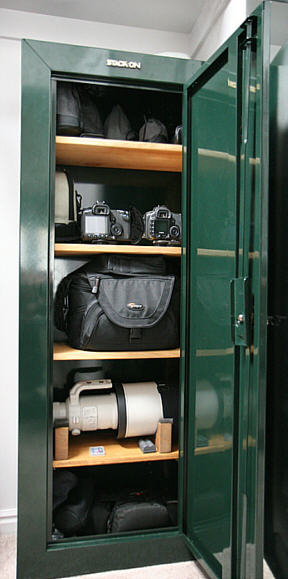
Steel Camera Cabinet
At present I am using a Canon EOS 60D, a Digital SLR with 18.0 megapixels. This Camera has awesome photo capability, considering the low price. With the higher pixel count, photos can be cropped to enlarge up to 5 times before loosing good resolution. My back up camera is a Canon EOS 40D with 10.1 megapixels. Before that I was using a Canon 20D and before that the EOS 300D, (Digital Rebel).
Many of the photos used on my Webpages have been digitally enlarged for a closer look. Most of the photos marked above 13x (taken with a Canon EF 100-400mm telephoto zoom using any of the cameras mentioned above, were magnified on the computer by cropping. Some of those marked at 26x were taken with the Canon EF 2x extender added to the 100-400mm, though I don't like using the extender with that lens. It doesn't provide very sharp photos with the extenders added. They say it's due to the 400mm end of the zoom lens not being sharp enough.
I recently bought a Canon 500mm fixed lens and also the 1.4 extender to go with my 2x extender. I chose the 500mm over the 600mm lens because it is smaller and lighter, being easier to handle. The 500mm lens will auto focus with the 1.4x extender attached, but not the 2x extender, (too much light loss). On the 100-400mm neither of the extenders will allow auto focus and I have to use manual focus. I can use both the 1.4x and the 2x extenders together on the 500mm getting quite sharp pictures, although it does require manual focus with both. With the two extenders used together I get a boost to 1400mm and with the camera cropping factor up to 2240mm equivalent, or 44.8x. You need plenty of light when using both extenders.
Example of Moon at 44.8x using both extenders
For any of you interested in using Canon's multiplier extenders, I want to warn you that the Canon extenders won't work on all of Canon's lenses. Only professional 'L' series lenses will attach to the extenders, and not even all of the 'L' series. The fixed/prime telephoto lenses will work fine, but only a few of the 'L' series zoom lenses will work and you will loose quality with those. Because of light loss, you will not have auto focus with many of these lenses. For zoom lenses you are better off cropping your photos to increase size, providing you have enough camera resolution to do so. The sharper lenses like my Canon EF 500mm prime lens will work good with either extender and even with both added together, but requires manual focus when using both.
The four cameras I mention above all have one feature that works great with any telephoto lens, the cameras magnify by a factor of 1.6. This is due to the digital sensor being 3/4 the size of 35mm film, which the lenses were made for. This causes the sensor to see a smaller portion of the view through the lens, in essence cropping the photo. It doesn't loose any sharpness or resolution, so actually magnifies the image. Also the center of any lens is the sharpest and produces better results. As an example, my 400mm becomes equivalent to 640mm. (Canon's 600mm lens costs more than $7,000, but I get even more magnification for less money). The part not so good is it also magnifies when using wide angle lenses. That is not wanted, so Canon produced some special lenses titled EF-S (Electronic Focus - Short). These lenses fit deeper into the camera to cover more of the sensor, thereby reclaiming the wide angle.
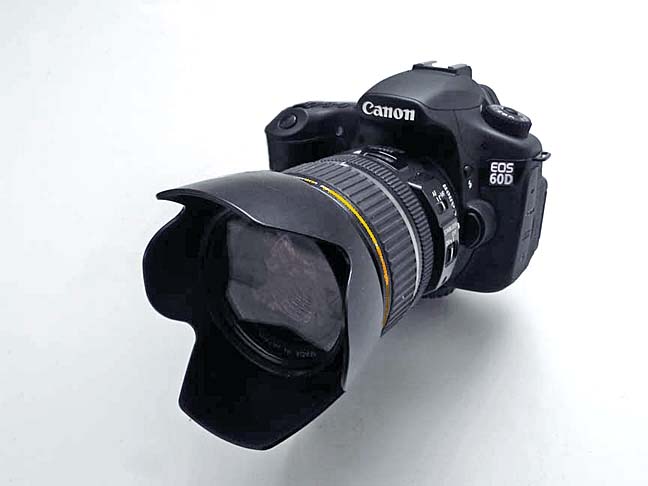
My Canon EOS 60D with the EF-S 17-85mm lens and sun hood

Back of the 60D, showing flip out display
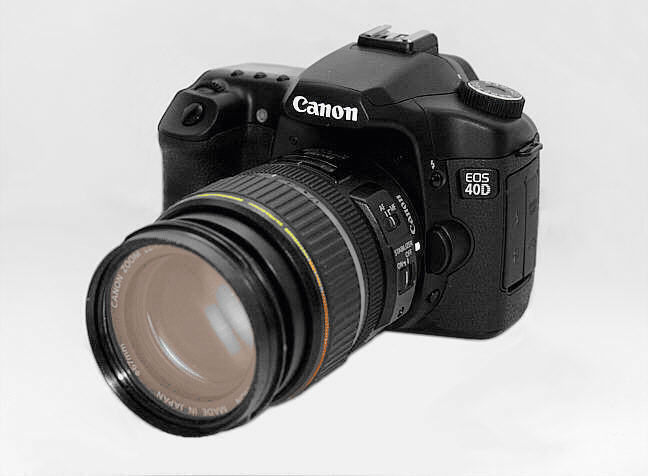
My Canon EOS 40D with the EF-S 17-85mm lens

Back of the 40D, showing 3 inch display
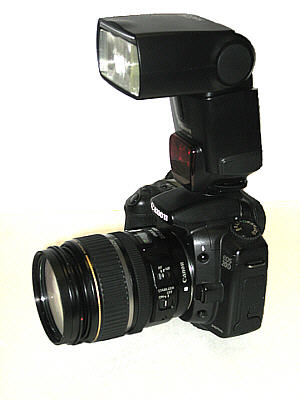
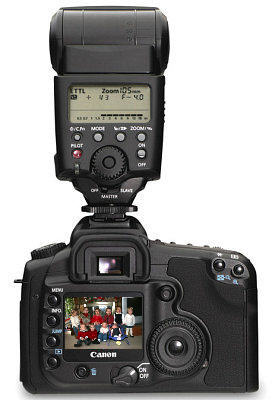
20D with 580 EX Speedlite
[an error occurred while processing this directive]
Visitors on site now (
[an error occurred while processing this directive]
)
Many of the photos used on my Webpages have been digitally enlarged for a closer look. Most of the photos marked above 13x (taken with a Canon EF 100-400mm telephoto zoom using any of the cameras mentioned above, were magnified on the computer by cropping. Some of those marked at 26x were taken with the Canon EF 2x extender added to the 100-400mm, though I don't like using the extender with that lens. It doesn't provide very sharp photos with the extenders added. They say it's due to the 400mm end of the zoom lens not being sharp enough.
I recently bought a Canon 500mm fixed lens and also the 1.4 extender to go with my 2x extender. I chose the 500mm over the 600mm lens because it is smaller and lighter, being easier to handle. The 500mm lens will auto focus with the 1.4x extender attached, but not the 2x extender, (too much light loss). On the 100-400mm neither of the extenders will allow auto focus and I have to use manual focus. I can use both the 1.4x and the 2x extenders together on the 500mm getting quite sharp pictures, although it does require manual focus with both. With the two extenders used together I get a boost to 1400mm and with the camera cropping factor up to 2240mm equivalent, or 44.8x. You need plenty of light when using both extenders.
Example of Moon at 44.8x using both extenders
For any of you interested in using Canon's multiplier extenders, I want to warn you that the Canon extenders won't work on all of Canon's lenses. Only professional 'L' series lenses will attach to the extenders, and not even all of the 'L' series. The fixed/prime telephoto lenses will work fine, but only a few of the 'L' series zoom lenses will work and you will loose quality with those. Because of light loss, you will not have auto focus with many of these lenses. For zoom lenses you are better off cropping your photos to increase size, providing you have enough camera resolution to do so. The sharper lenses like my Canon EF 500mm prime lens will work good with either extender and even with both added together, but requires manual focus when using both.
The four cameras I mention above all have one feature that works great with any telephoto lens, the cameras magnify by a factor of 1.6. This is due to the digital sensor being 3/4 the size of 35mm film, which the lenses were made for. This causes the sensor to see a smaller portion of the view through the lens, in essence cropping the photo. It doesn't loose any sharpness or resolution, so actually magnifies the image. Also the center of any lens is the sharpest and produces better results. As an example, my 400mm becomes equivalent to 640mm. (Canon's 600mm lens costs more than $7,000, but I get even more magnification for less money). The part not so good is it also magnifies when using wide angle lenses. That is not wanted, so Canon produced some special lenses titled EF-S (Electronic Focus - Short). These lenses fit deeper into the camera to cover more of the sensor, thereby reclaiming the wide angle.
As I mentioned, telephoto zoom lenses are not as good when it comes to quality as a professional 'L' series 'Prime' fixed lens. It's a trade off for me. Very often the subject I am shooting will be at a distance where a fixed lens would over magnify. The variable zoom allows me to zoom back a little to get all the subject into the photo. For those shots that are way out there, my 500mm works best.
With my standard lens, a Canon EF-S 17-85mm wide angle to 5x zoom, and the 100-400mm, I can photograph at just about any distance. Where I am often out hiking in the mountains, I try to keep my camera weight down, so only take two lenses along. I carry the camera with a small lens in my belt pouch and a larger lens in my backpack, either my EF 70-300mm or the 100-400mm. I have carried the larger 500mm on hikes, but it is very heavy and won't be carried on hikes very often.
With my standard lens, a Canon EF-S 17-85mm wide angle to 5x zoom, and the 100-400mm, I can photograph at just about any distance. Where I am often out hiking in the mountains, I try to keep my camera weight down, so only take two lenses along. I carry the camera with a small lens in my belt pouch and a larger lens in my backpack, either my EF 70-300mm or the 100-400mm. I have carried the larger 500mm on hikes, but it is very heavy and won't be carried on hikes very often.
By the way, each of these lenses have IS, (Image Stabilization). With the IS, I find that I seldom need to use a tripod, although I do use a monopod most of the time with the 500mm.
My Canon EOS 60D with the EF-S 17-85mm lens and sun hood
Back of the 60D, showing flip out display
My Canon EOS 40D with the EF-S 17-85mm lens
Back of the 40D, showing 3 inch display
Canon Speedlite 580 EX external flash:
This flash unit reads information through the camera's lens and sets up perfect shots. The Speedlite 580EX receives sensor size information from the camera and determines the flash’s zoom position then adjusts accordingly, thus optimizing flash coverage and reducing the amount of charge required per shot. The unit distributes a consistent, even spread of light throughout the entire zoom range. Another feature is transfer of color temperature data from the flash to the camera to optimize the white balance compensation.
This flash unit reads information through the camera's lens and sets up perfect shots. The Speedlite 580EX receives sensor size information from the camera and determines the flash’s zoom position then adjusts accordingly, thus optimizing flash coverage and reducing the amount of charge required per shot. The unit distributes a consistent, even spread of light throughout the entire zoom range. Another feature is transfer of color temperature data from the flash to the camera to optimize the white balance compensation.
20D with 580 EX Speedlite